
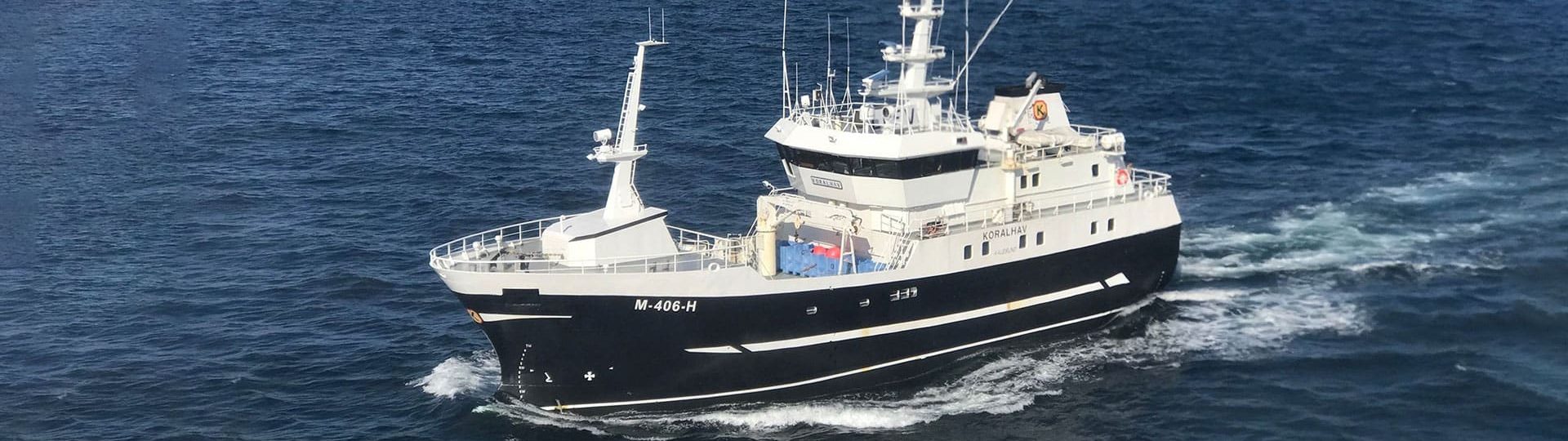
The longliner Koralhav, built in 2000, harvests whitefish and holds quotas for haddock, saithe, cod, tusk and ling. Around half of Koralhav’s catch goes to the fillet industry – which makes the quality of the frozen-at-sea fish absolutely critical.
Owner Ronny Nogva is clear that quality was the deciding factor when choosing a new freezing system.
“Nofima reports show clearly that rapid freezing and achieving a sufficiently low core temperature are key to preserving product quality over time,” he says.
Rapid freezing
SuperFreeze is an efficient CO₂-based system that freezes fish far faster than conventional solutions.
Roy Fjellstad, Sales Manager Marine & Industry at PTG Kuldeteknisk, explains:
“The SuperFreeze system is designed for freezing down to –50 °C and provides up to 25 per cent faster freezing and 25 per cent higher capacity than traditional systems. This results in improved quality and helps maintain it over time.”
Nogva says that the expectation of improved quality was crucial in the decision:
“We see this as a major step forward for the company. Even if market prices don’t increase overnight, stronger quality will benefit us in the long term.”
Lower greenhouse gas emissions
The upgrade is also driven by the company’s desire to phase out the vessel’s existing HFC system (hydrofluorocarbons) – a group of synthetic refrigerants with high global warming potential.
“HFCs have to go. They are a climate-unfriendly gas, and we want a more environmentally responsible system,” Nogva says.
In addition, the new system offers better operating characteristics at low load, which can help reduce the vessel’s climate footprint. This is because SuperFreeze uses several smaller compressors with lower capacity, and can modulate output as needed. During transit, when the load is low, the system can therefore run more gently.
“The machinery will mostly run at low load after the rapid-freezing process. This means lower energy use – and therefore lower emissions,” Nogva explains.
With increased capacity, the vessel can also handle both large and small catches more efficiently.
“Even with limited volume, we can get the fish into the freezer store more quickly. It makes our operations on board more efficient overall,” he says.
Starting early in the new year
Installation work begins in January 2026, meaning Koralhav will operate with the new freezing system for most of the 2026 season.
Fjellstad says PTG Kuldeteknisk is looking forward to the delivery:
“We greatly appreciate the trust from Kowi and Koralen. This is a modern system that will deliver noticeable benefits in terms of quality, capacity and climate impact.”
About Koralhav
Koralhav was built in 2000 and holds quotas for cod, saithe, haddock, tusk and ling. As of 2025, the vessel had landed 2,083 tonnes of whitefish. It is owned by Koralhav AS in Brattvåg, and in 2025 became part of Kowi AS – a collaboration between the Koralhav owners and the Williksen family.
Contact me if you want to know more about freezing plants
Roy Arild Fjellstad
Sales Manager Marine and Industry
Tel: +47 928 48 835
rfj@ptg.no